

It would seem that I have no control over my own life.
So…
The plan had been to just have a daytrip to Royston Cave. This is a fascinating place that I have visited previously - but prior to my mission to visit some of the more interesting (energetically or otherwise) places in Britain. Since discovering that it is a crossing point of the Michael and Mary energy currents, I clearly have to go back as part of my themed travel. Ticket booked, all well and good.
And then American Express offered some cashback on Premier Inn stays and suddenly a mini expedition is on the cards.
I am so easily swayed. It’s pathetic.
Whatever. It does afford me with the opportunity to visit the 3 easternmost coming together points of the currents, visit some other cool places and pop in to see some old friends so I will keep the self-flagellation to a minimum.
Thus I find myself setting out early on a Saturday morning for a long trek to Suffolk. I had a minor panic the day before when I realised that I had only booked one night of accommodation rather than two, but snafus are par for the course on my travels and this is minor and easily dealt with in the grand scheme of things.
Sutton Hoo has been on my list of places to visit for some time, but it is somewhat remote. Not on this trip though.
You can tell when you get into Suffolk. Apart from it feeling very remote (it is) and somewhat otherworldly (likewise), there is the sudden onset of pink-washed cottages. I believe that the initial recipe for “Suffolk Pink” called for the inclusion of pigs’ blood, but I'm not sure whether this is still the case. When I ask AI to clarify this, it is somewhat vague on the actual constituents, but happily goes into celebrity gossip mode, telling me that in 2013 Marco Pierre White was forced to repaint his restaurant (which had been decked out in a “pale blancmange shade of pink”) as the local council deemed it an inappropriate shade for a listed building.
You don’t mess with tradition.
Anyway, arriving at Sutton Hoo and queueing up to flash my National Trust membership card, the woman working the queue asks me if I have been before. When I answer in the negative, she looks surprised and tells me that I look as though I have. I have no idea what this means. Do I just look old enough to have visited everywhere? Do I look knowledgeable and possibly with an interest in archaeology? Or do I just have a depressingly generic face which she thinks she has seen before?
She clearly realises that this is an odd thing to say and mumbles something to that effect. I resist the urge to have some fun and scoot through so as not to extend the moment of awkwardness.
Sutton Hoo is a site of major archaeological significance. It is a burial area for a family of 7th century East Anglian aristocracy, the Wuffingas. In addition to lots of impressive finds in a number of the mounds (and nothing in previously looted ones) there were warriors buried with their horses. The site is most famous though for the ship burials. In 1939, an excavation uncovered a large ship (or at least what remained of it - obviously the wood had gone but the outline and the iron rivets remained), thought to be the burial of King Rædwald.


This being a National Trust site, there is also a second hand book shop. Usually it is slim pickings in these places, but this time I am taken by 3 volumes, one a not insubstantial tome, and foolishly buy these on the way in and then have to haul them all around the site. Didn’t really think that one through…
Apart from the burial mounds, there is also an exhibition with some replicas of the treasures found here (the originals were sent to the British Museum, much to the irritation of the representatives of the Ipswich Museum I gather) and access to the house were Edith Pretty lived. Edith was the owner of the land when the excavation took place and is portrayed in the film, Dig, which tells the story of the excavation, by Carey Mulligan and the exhibition touches upon this too. I felt that the experience could have been somewhat enhanced by a meet and greet from Ms Mulligan, but alas no.


Moving on from Sutton Hoo, it occurs to me that I am not far from Rendlesham Forest. This is somewhere else that I have been before, but I think it bears another visit.
Anyone who has spent a lazy Sunday afternoon channel hopping and stumbled across reruns of “Ancient Aliens” will be familiar with Rendlesham Forest as the “British Roswell”.
Around Christmas of 1980, a number of sightings of strange lights were reported and followed up by US Airmen from the local USAF bases. People have tried to explain it away as lights from nearby lighthouses seen through the forest. Also, nearby Orford Ness was an Atomic Weapons Research Establishment base and who knows what they were up to during the cold war!
That said, the US airmen, reported close contact with a triangular craft. One even touched the craft and claimed to have had an information download. It is a short hike to the glade where this supposedly took place. Why would anyone not visit that?


Unlike the original Roswell (where the whole town has leant into the UFO phenomenon), there is nothing other than the UFO replica here. No UFO shaped McDonalds, no aliens offering Dunkin Donuts. Is it British understatement or just the inability to make the most of your history?
Whilst I am on the trail of little green men, I decide to call at Woolpit on my way to the hotel in Bury St. Edmunds. Woolpit also had its little green men, or rather two green children who mysteriously turned up there.
According to contemporary (11th century) reports, two children with green skin were discovered wandering in the wolf traps (Wolf Pit is where the village name comes from). They spoke a foreign tongue, were wearing strange clothing and appeared unable to eat anything until they discovered raw broad beans.
When the children were able to communicate, they claimed that they had entered a cave in their native land, followed the sound of bells, and emerged in Woolpit. They claimed that their home country was underground and referred to it as St. Martin’s Land.
One theory is that they were part of a wave of Flemish immigrants. I am unconvinced. Anyway, the boy apparently sickened and died but the girl eventually lost her green tinge and integrated into society (although one of the historians documenting the case apparently felt the need to call out her moral impropriety for some reason - typical greenist behaviour!)
I have friends who live in Norfolk who have told me that there is a shorthand used on medical notes, for odd but non life threatening genetic traits - extra digits, missing noses and suchlike. The shorthand is NFN, standing for “Normal for Norfolk”. I cannot speak to the veracity of this, but maybe Similar For Suffolk also applies and this could explain the green mutation…
Whatever the truth of the situation, their story is immortalised in the Woolpit village sign, and it is this that I have stopped to take a photo of.


As I park, I notice that there is a village museum. These sort of places are usually delightfully quirky, so I head on in. They are just about to close, but the two old boys running it seem in no hurry to leave and, as I am apparently their only visitor that afternoon, kindly allow me to have a look around. When I ask about the green children, this is quickly dismissed as nonsense, just a story. They are keen to draw my attention to Woolpit’s preeminent place in the world of brick making. Fascinating as bricks undoubtedly are, I try to steer back towards more interesting (to my mind) folkloric territory. I think it is fair to say that there was not a meeting of minds here. Still, I appreciate them staying open for me.
Back to Bury St. Edmunds for my first visit. Apart from this being another spot where the Michael and Mary lines come close together, and a very pleasant town, this is where King Edmund (grandson of Alfred the Great and younger brother of Athelstan, the first King of the whole of England) was buried.
This is one of the less confusing British place names I feel.
Edmund was killed at nearby Hoxne by Danes. The story goes that he refused to fight the heathens and walked out to meet them, at which point he was shot full of arrows and then beheaded. There is, however, a suspicion that this version of his death was a narrative that the church developed to support the case for martyrdom and subsequent canonisation.
Seems to have worked as King Cnut later decreed that an abbey should be built in honour of the late, sainted King, and Bury St. Edmunds Abbey was one of the most impressive and powerful abbeys in the land for a time. The scale is staggering and one can only imagine what it looked like in its prime, before Henry VIII had his way with this and so many other abbeys.


Still, these days the local Wetherspoons is even more impressive.


I must be more tired than I thought after all the driving, as I find some bubbles on the table strangely fascinating. This is, of course, the peril of travelling alone: the mind can tend to wander. Who is that idiot taking photographs of beer bubbles?


Probably time to head back to the hotel!
Just as well I hadn’t found a gig to go to. When I checked to see what was on in Bury this weekend, this was the outcome:
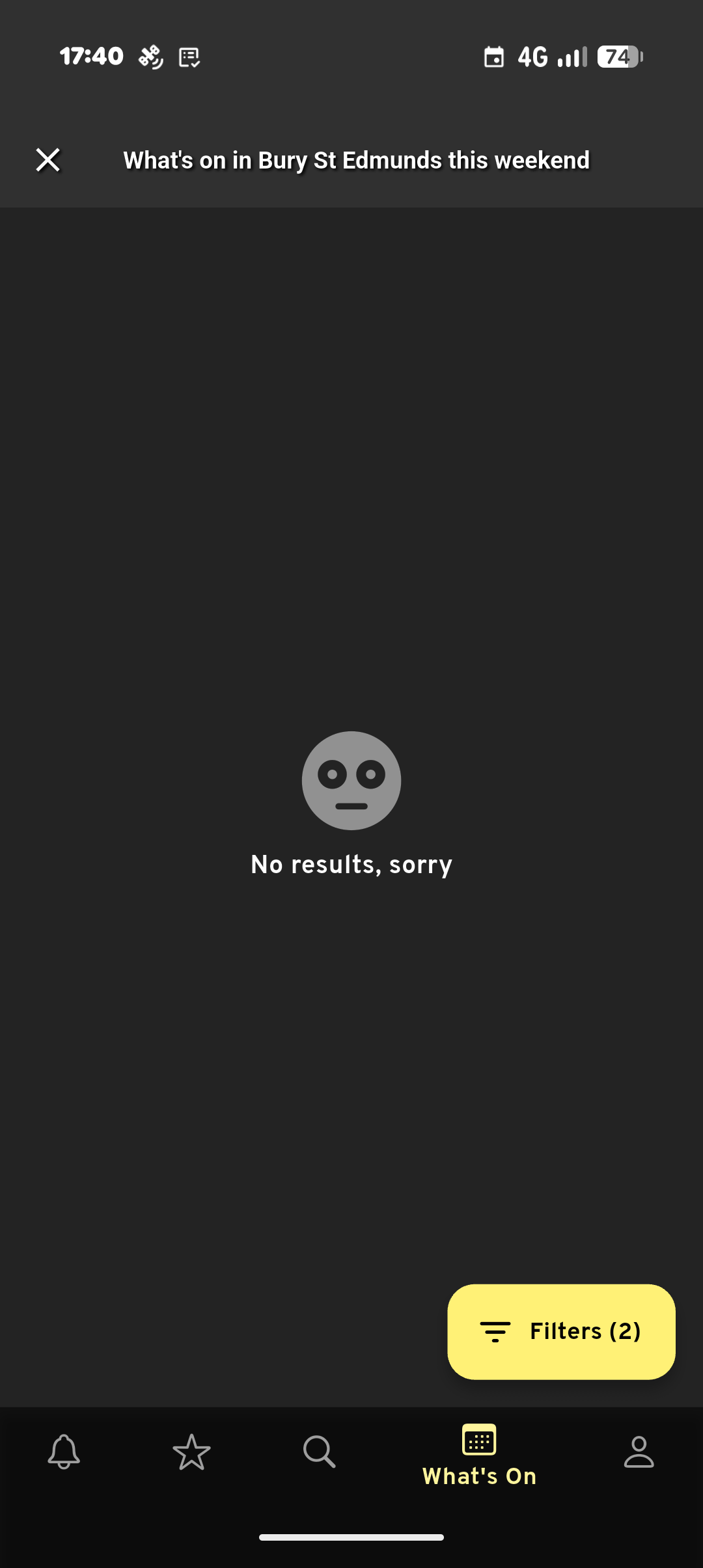
Sleepy Suffolk indeed…
"I have no idea what this means."
She means you look like an archeologist who has investigated the site with his man(TM) before.