

Given that the Samaria Gorge is closed, I have decided to treat myself to a trip to Santorini. I have always wanted to see the caldera there, so seems like the ideal opportunity. Of course it also means that I am ticking off 3 of the putative locations for Atlantis this year. Not that such things in any way influence my decisions of course. Anyway, more of that later.
I head to the booking office to arrange my tour but it doesn’t seem to be open at the usual time. There is some running event (as in an event with people running, as opposed to an ongoing event, although that too I suppose) taking place and some of the roads are cordoned off. When it finally opens, I ask the lady in the office what the event was about.
Well.
This triggers a 10 minute good-natured grumble. She had been unable to drive anywhere near the office and the morning tour buses had been unable to reach their pickup points. Apparently her sister lives in Gouves and didn’t know about this event and neither did the police that she spoke to - they had just been called in at the last minute. She said that this was typical of Greece and that in any civilised country these things would all be planned in advance and relevant parties informed. I evinced the opinion that it keeps life interesting. She didn’t entirely disagree but was definitely veering more in the direction of irritation.
It seems that mentioning organisation of anything official in Greece has the same effect as talking politics to a taxi driver in the UK. I’m guessing that this also explains how the Samaria Gorge is still closed with no one having any idea when it will open.
I wander away smiling and clutching my ticket, happy to have been able to help someone de-stress by listening to a cathartic rant. Thank goodness for all those years in management.
As another positive, as the wind picks up later in the day, I discover that I may have been too hasty in the assessment of my “balcony". It turns out that the wind resisting properties of a subterranean balcony are not to be underestimated. An object lesson in not making snap judgements I feel.
Time to ramp up the tourism rather than just pottering about between eating and drinking. Today I am off to Knossos, another one from the long term wish list.
A bit of history… (In italics if non history buffs feel the need to skip!)
Crete has been occupied since about 7000 BC - one of the earliest to be inhabited in the Mediterranean (even Malta with its ancient temples wasn’t inhabited until about 2000 years later). Knossos was occupied from the beginning but the palace for which it is famous was only (only he says!) constructed about 4000 years ago. There were a number of “palatial” phases on Minoan culture with other palaces being built at Phaistos and Malia slightly later.
The standard narrative of history (or at least what most people have been exposed to) is that the Minoan civilisation was wiped out by the huge volcanic eruption at Thera around 1600 BC (which created the caldera and archipelago of islands which is now Santorini) and the subsequent earthquakes and tsunami.
This, it turns out, is false.
Whilst huge damage was done, the Minoan civilisation survived and they built back bigger and better (at least at Knossos). The guide that I had for the Knossos tour claimed that the Minoans were finely attuned to nature and that, when they saw the animals fleeing, they took the hint, abandoned the buildings and headed to high ground. I guess if you live in a geologically active region, you develop a sense for these things. Anyway, apparently there is no archaeological evidence of people being killed by the tsunami.
The Minoan culture persisted for several hundred years after this before being absorbed into the Mycenaean culture and finally biting the big one at the same time as the other bronze age cultures in the Med which all mysteriously collapsed over the course of the 100 years from 1250-1150BC.
I am visiting Knossos on a particularly warm day and, as I quickly discover, there is little shade available at the site. One guy was stretchered out while we were there. I’m not sure whether this was a fall, heat stroke or apoplectic fit at the amount of queueing involved, but you have to admire that dedication to seeing the sights. Yes, Knossos is particularly busy. I dread to think what it is like in the actual summer peak season. We queued for about 20 minutes to get into the throne room.
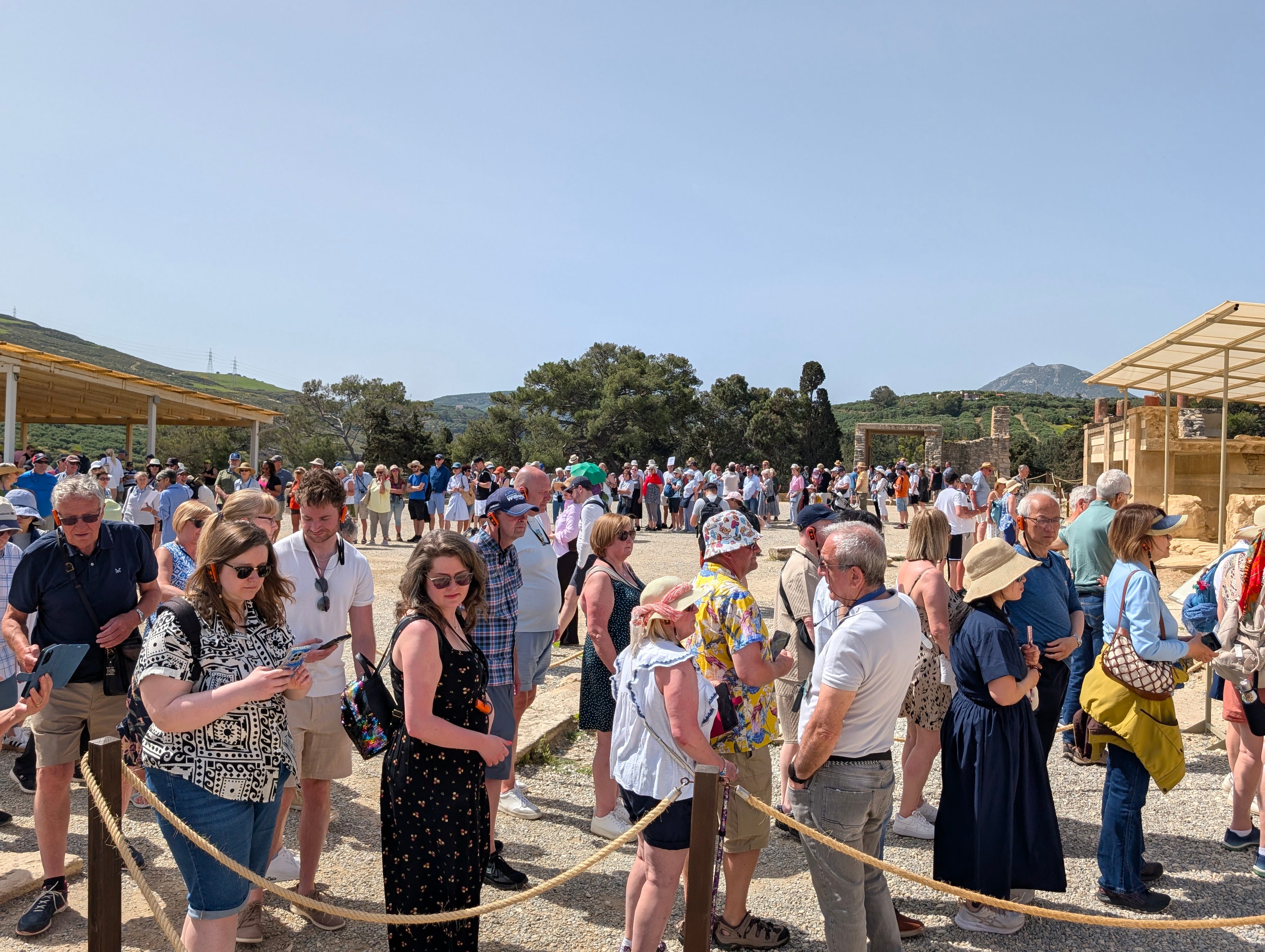
Still, we got to see a seat.
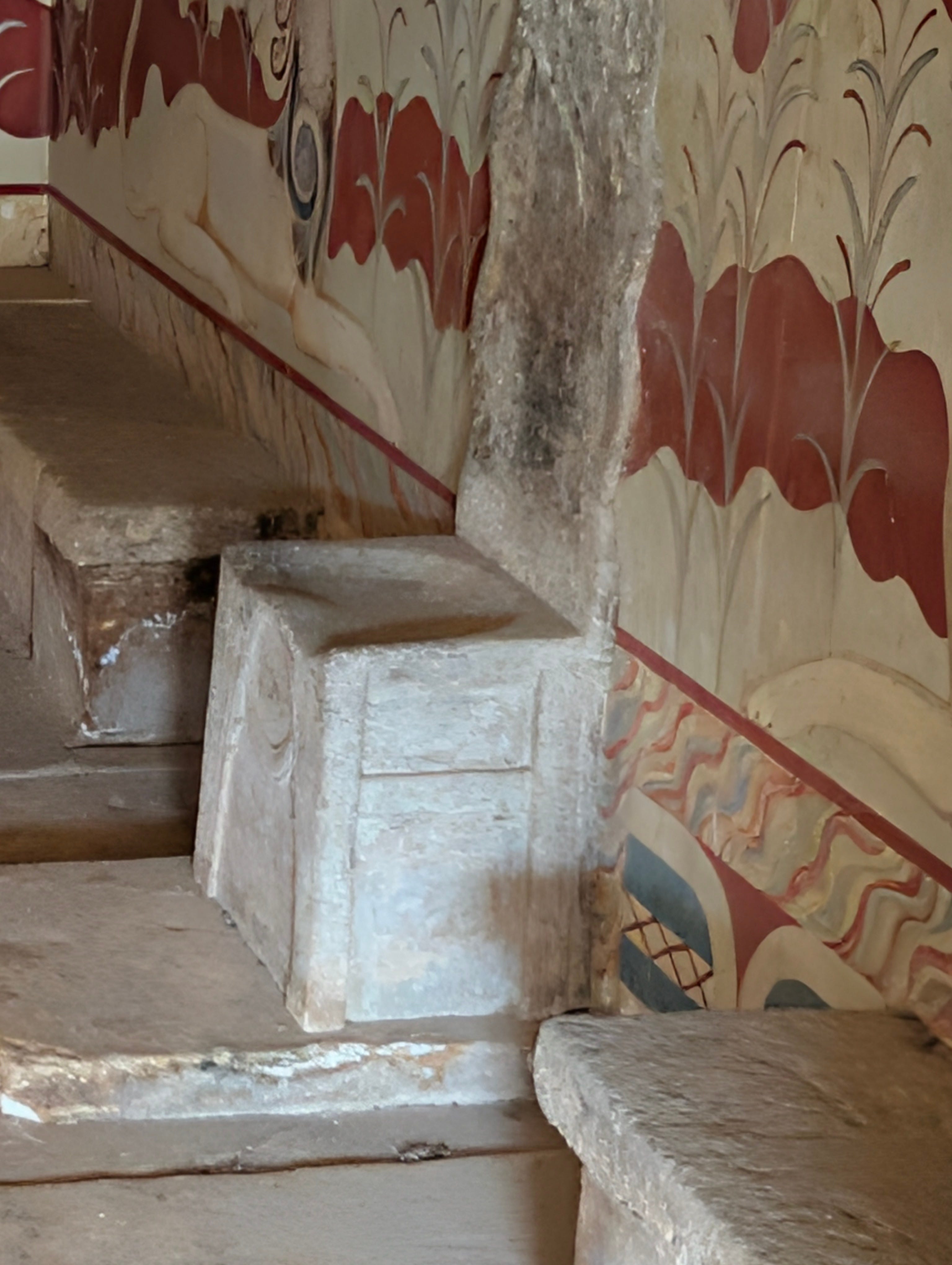
I sound cynical but Knossos is an impressive site, and huge (although not all open to the public).


I have two beefs with this visit…
Firstly much of Knossos is reconstructed. I am not a fan of restoring ancient sites, I feel they should be left as found, although I think in this case it may have been structural necessity.


Secondly, I was led to believe that we would have some free time to wander around on our own, but we were taken on a fairly strict route and then herded back to the bus.
The guide was very good, going into some detail on the mythology and the various reasons why the bull was such an important symbol in Minoan culture. She covered both the Europa/ “Zeus as bull” liaison which lead to the birth of King Minos and the bull sent by Poseidon which Minos refused to sacrifice and so Poseidon made Minos’ wife fall in love with it as punishment. She then had Daedalus construct a fake cow with a space in which she could be suspended … you can guess the rest. And this lead to the Minotaur. Oh those saucy Greeks! Puts me in mind of stories about Catherine the Great.
This explains why representations of a bull are often present in sacramental spaces in Crete.
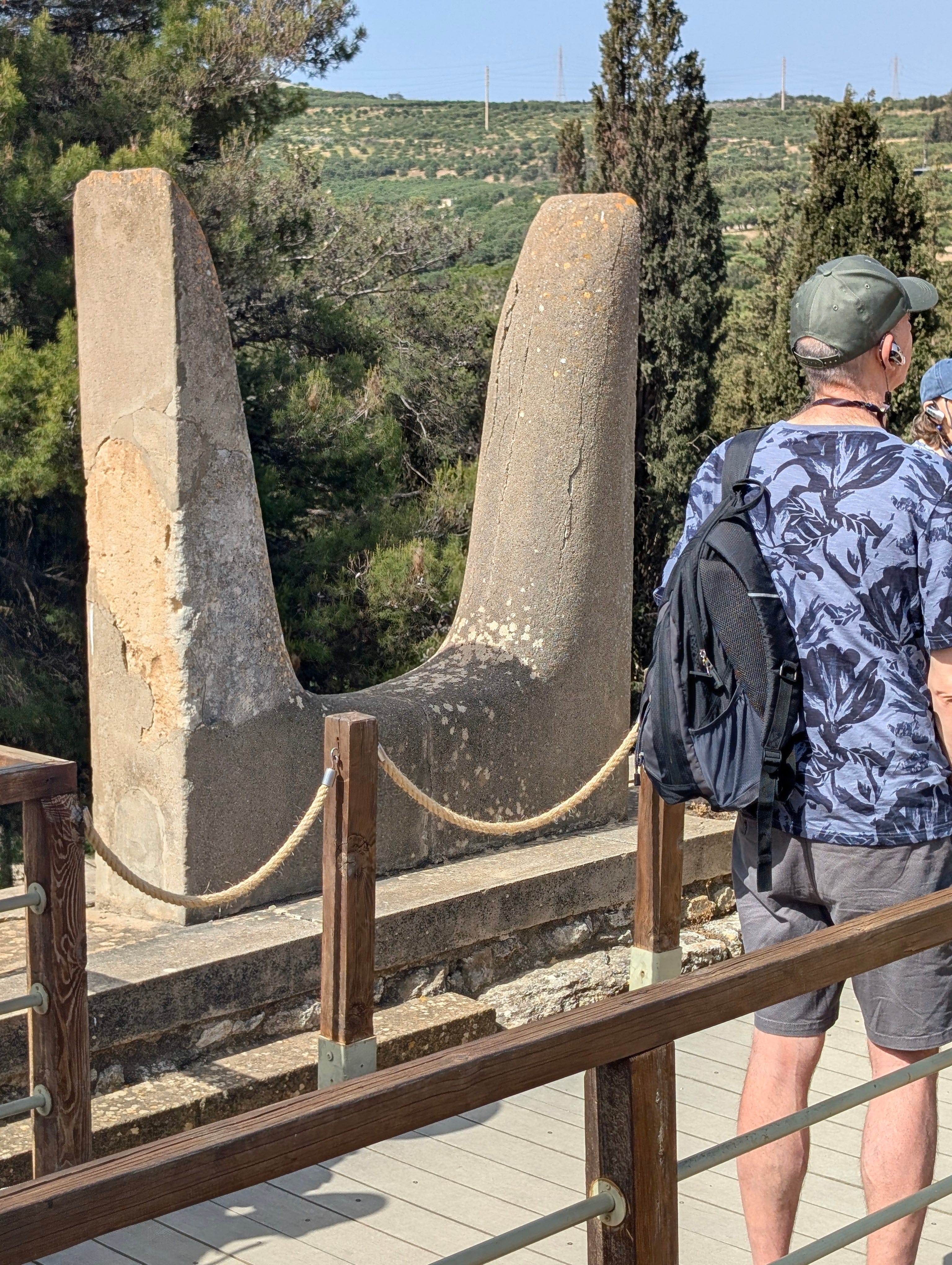
Anyway, the upshot of imparting all of this mythological knowledge (delivered with much theatrical verve) was that no spare time was available for exploration before being whisked off into the centre of Heraklion.
At least I had a chance to take a snap of the oldest road in Europe…
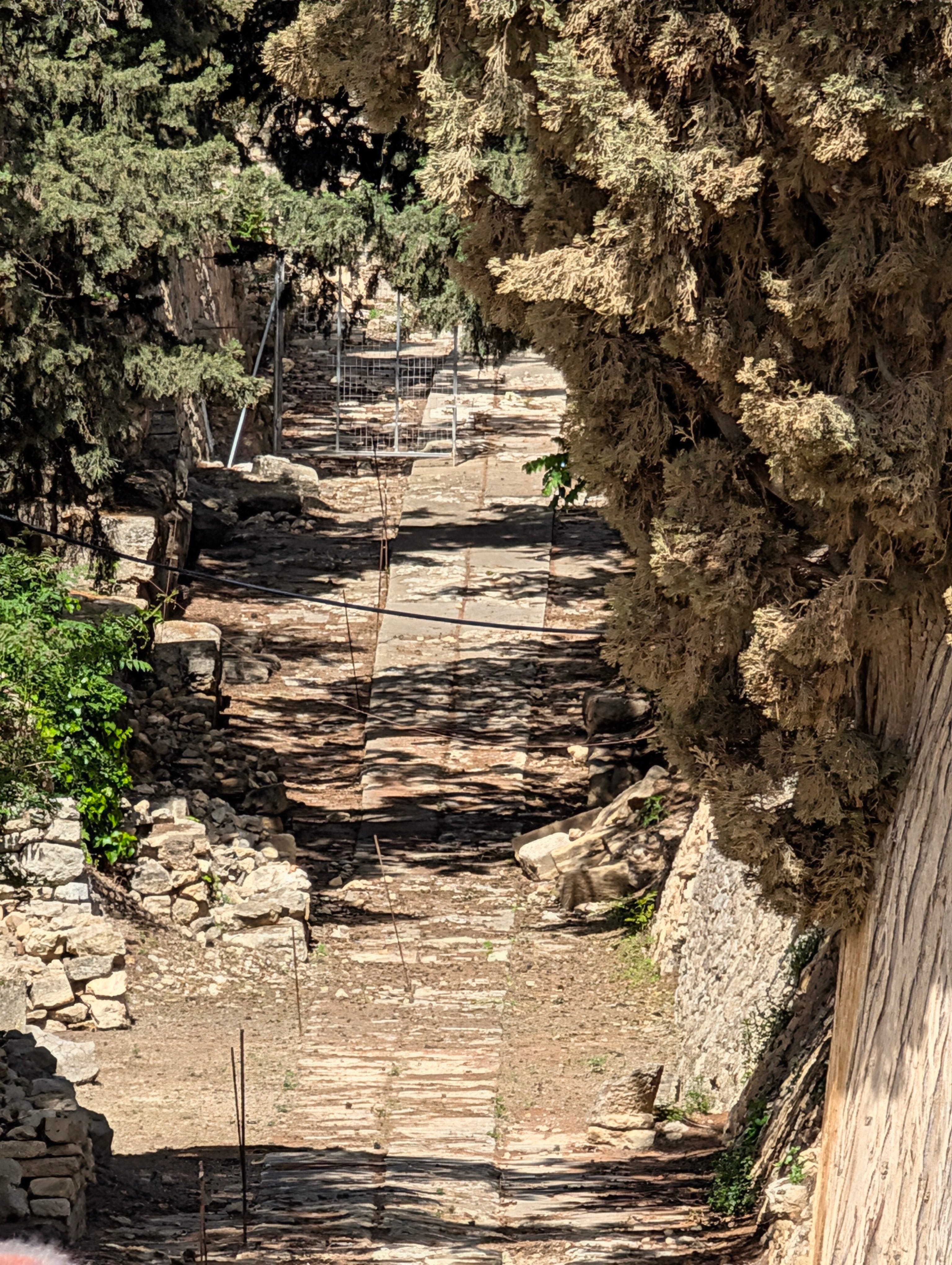
… and the fine drainage system. Knossos had impressive plumbing, with running water in some of the more important rooms and full waste disposal.
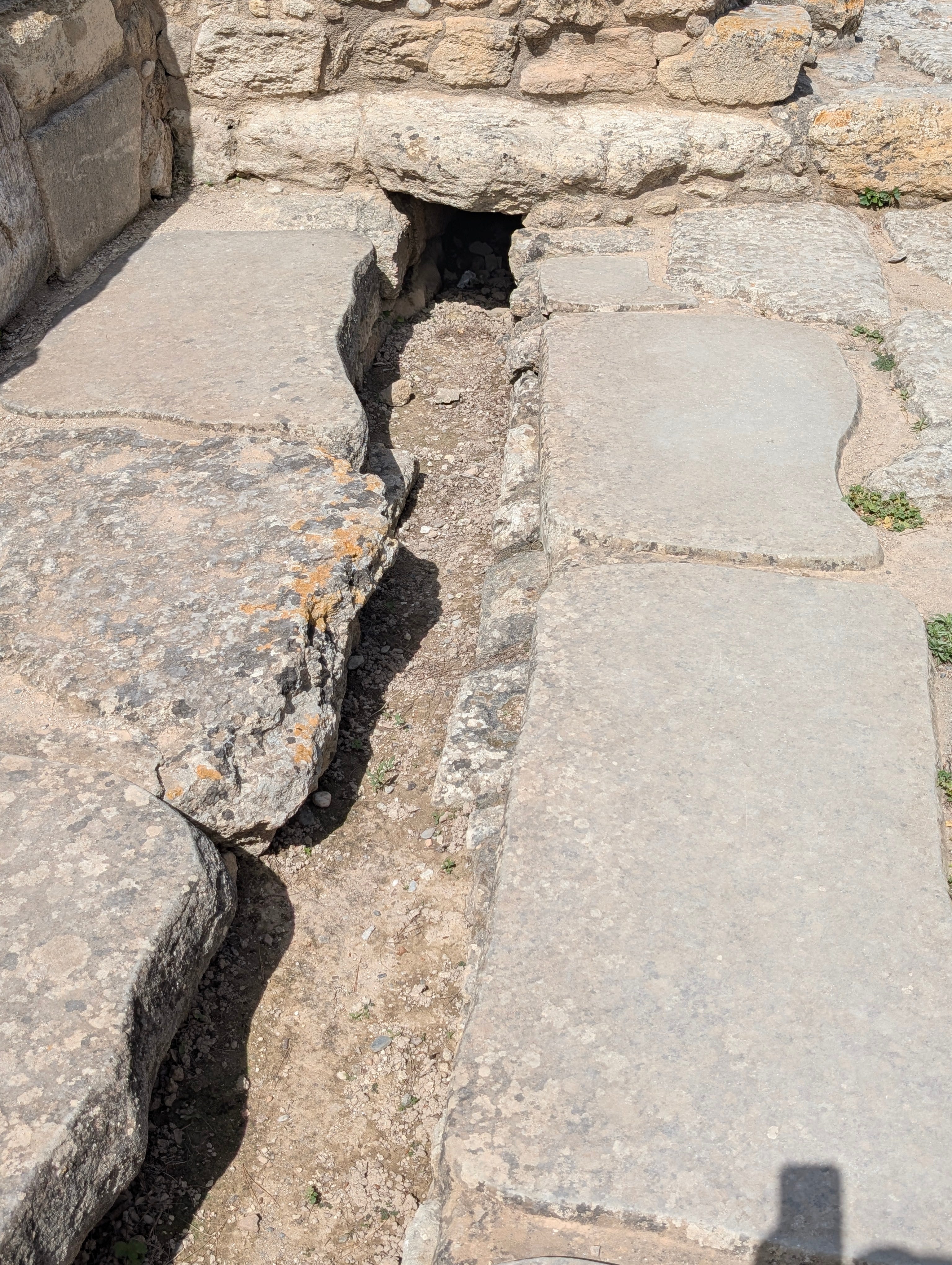
So they had nice wide drains 4000 years ago and yet today the plumbing is insufficient to handle flushing of toilet paper. Go figure.
Onwards to Heraklion and, after a brief walking tour to orient us, I head straight for the archaeological museum. This is fantastic and has some great exhibits. It again strikes me that some of the oldest artefacts are as impressive, if not more so, than some of the more recent ones. This feeds into the narrative of there perhaps having been more advanced knowledge and culture further back in history than is generally accepted, but I won’t bore you with that now!


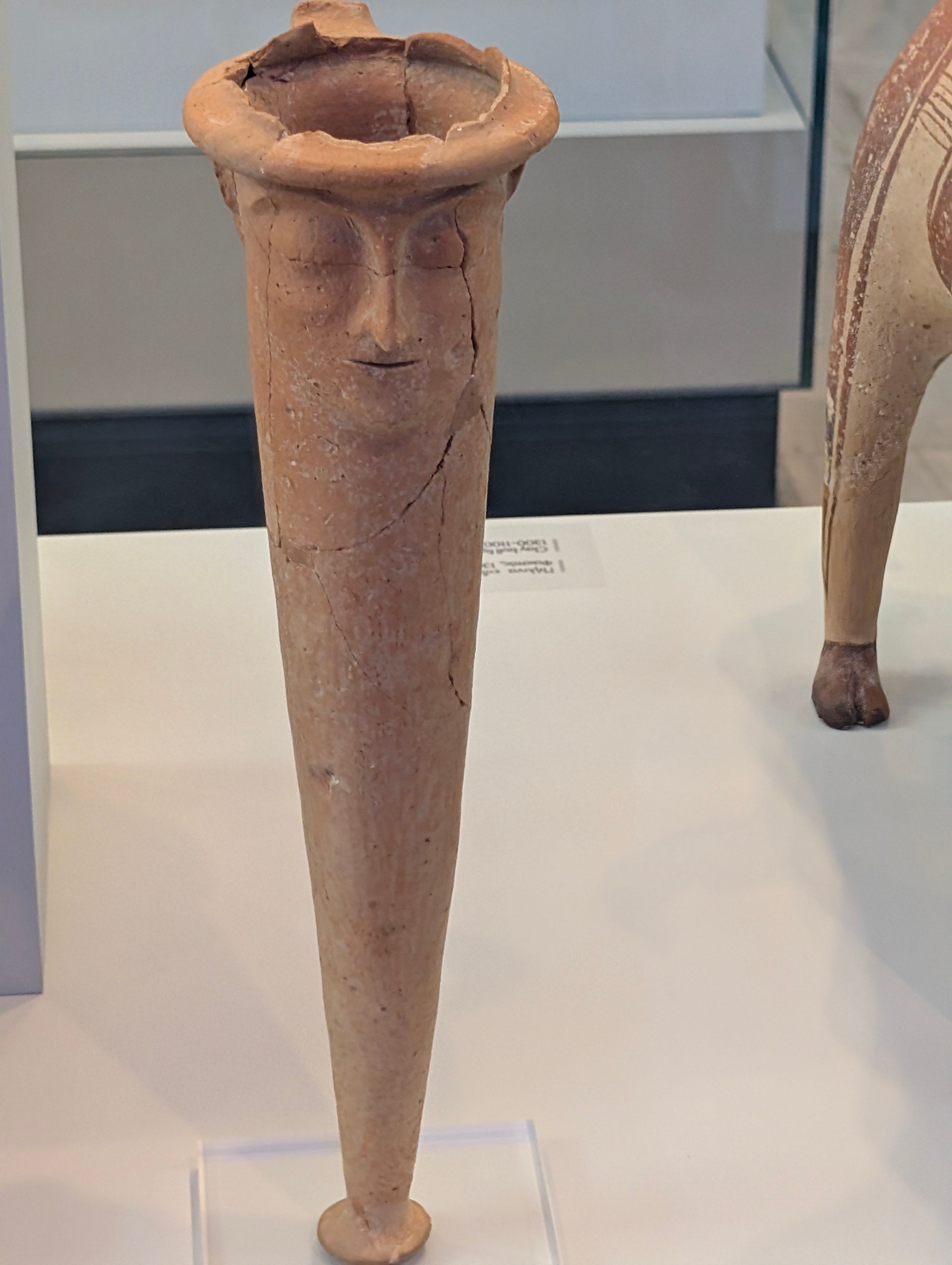
I found this one strangely disturbing for some reason
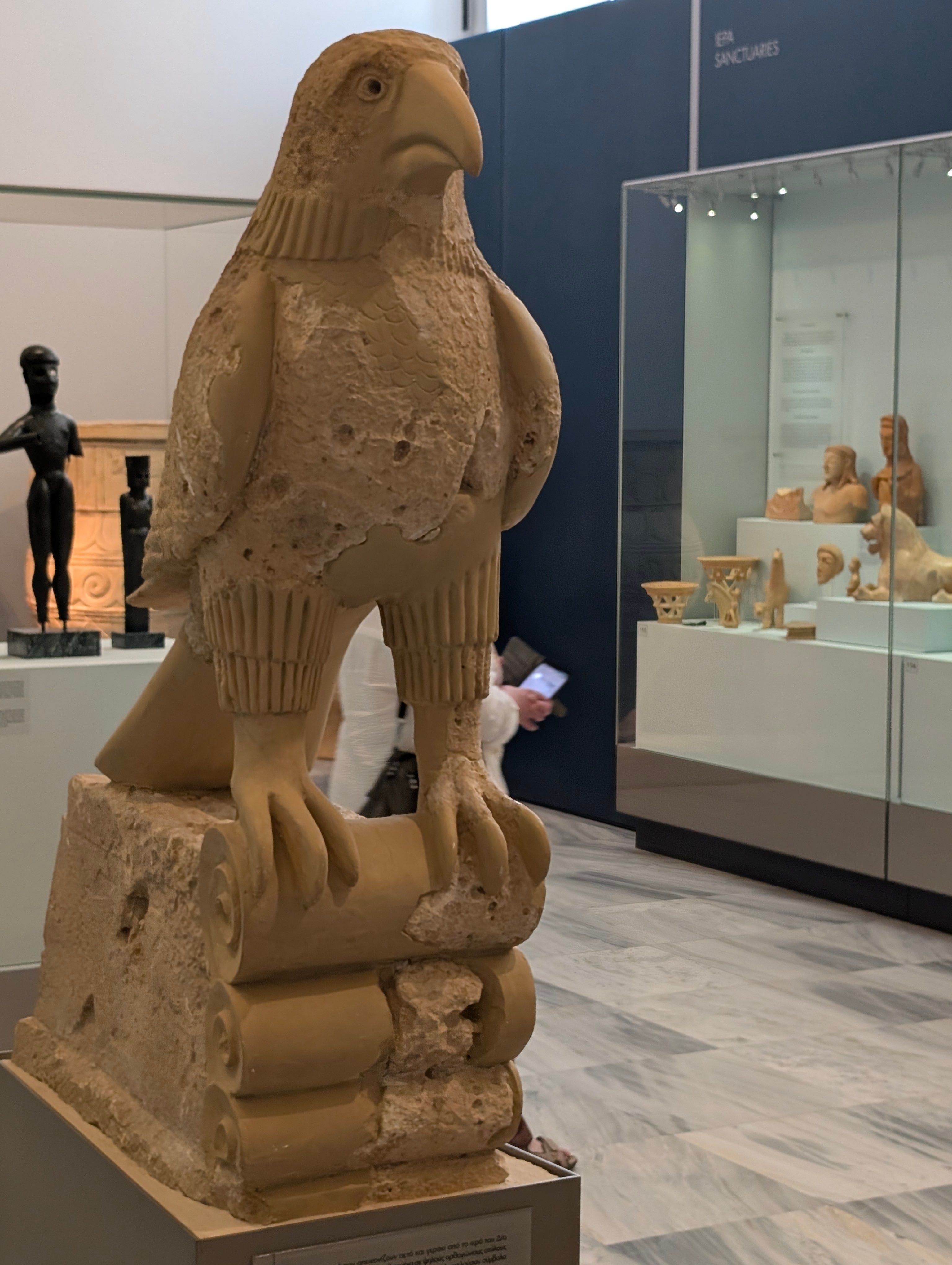
but I need one of these for my garden to fend off the pigeons
And of course there is the Phaistos disc. This is a mysterious object (found at the palace of Phaistos unsurprisingly) containing mysterious symbols and seen as evidence of the existence of movable type thousands of years before the printing press. The writing on the disc has never been translated. This is something of a theme with Cretan writing as the Linear A script has also never been translated. I love a good mystery!


Leaving the museum, the temperature has gotten out of hand. It was supposed to top out at 28C today but seems to have slid up to a cheeky 38C. That is some poor-ass weather forecasting. I need to find some shade whilst waiting for the bus, but it is in short supply.
Heading back to my apartment, I exchange a few words with the waiter in the attached taverna, which triggers the thought of cold beer, which somehow makes the heat more acceptable.
Lesson of the day: although it is always useful to get information from guides, I don’t think organised tours are really for me. Without a hire car (and in Crete I would fear to go down this route I think) an organised tour is often the easiest way just in terms of transport, but it is not well suited to my random bimbling style of tourism!