

Today I am resisting the temptation to hide indoors as the UK temperatures soar into the 30s once more and decide to head out into Derbyshire. In between more wide-ranging trips, I have been discovering the joy of locally “hidden” treasures.
The intention is to head to Arbor Low Stone Circle. I have seen a map with many Ley Lines converging on Arbor Low and so decide that, in the spirit of inquiry, I need to check this for myself. Now whilst looking at Google Maps, I see another site : Minninglow. This is not somewhere that I had previously been aware of, which is surprising, given my penchant for visiting ancient sites. Minninglow is one of, if not the largest burial chambers in Derbyshire.
It towers magnificently over the surrounding countryside, being particularly distinctive in that the tombs are surrounded by a double ring of beech trees.
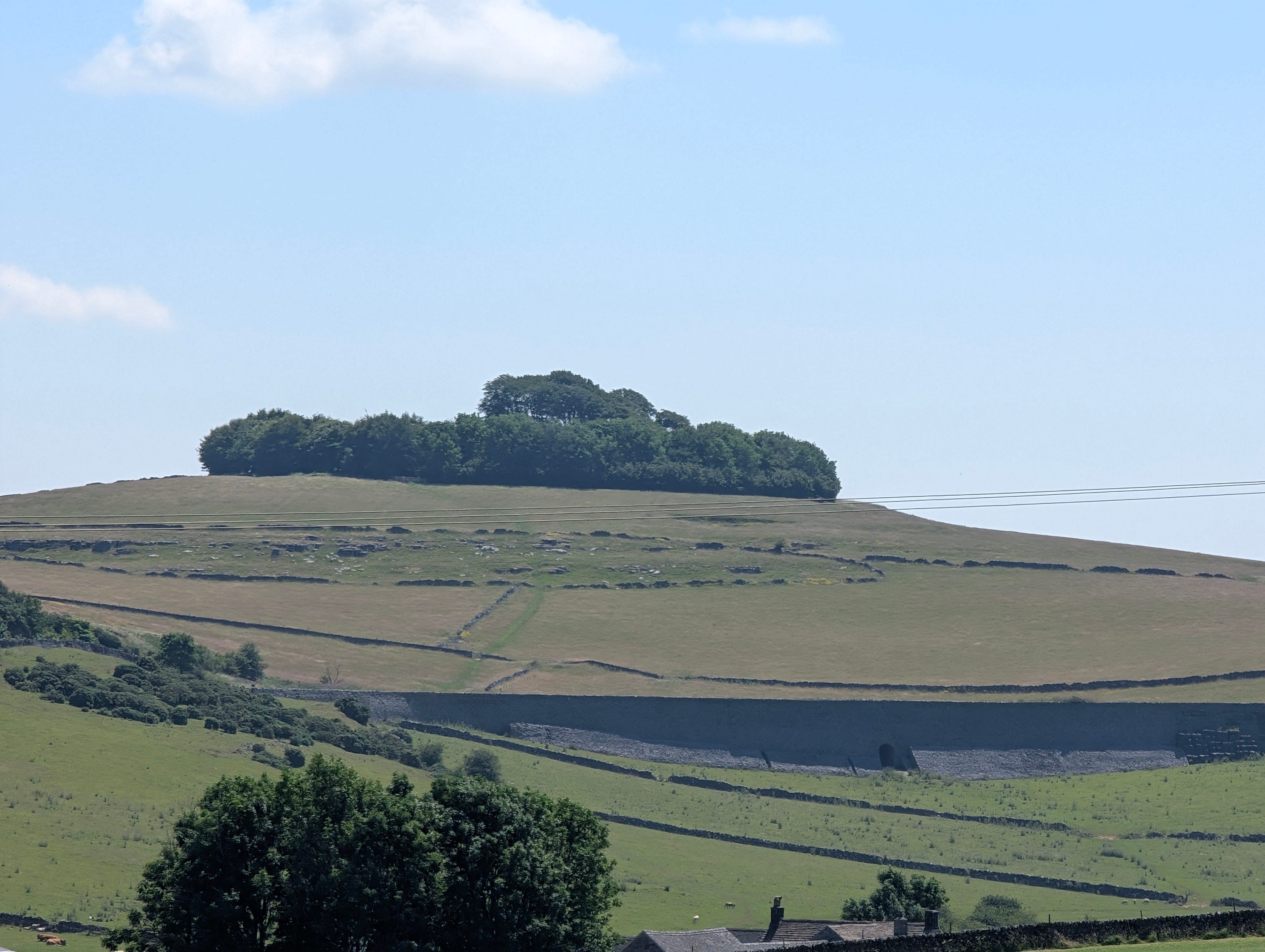
How did I not know about this place?
It turns out to be a very pleasant walk, largely along a section of the High Peak Trail - pleasant but with an annoying number of cyclists who expect you to get out of their way despite the signs clearly stating that they should give way to walkers. Whatever, it is too nice a day to slip into the role of curmudgeon.
It turns out that the walk passes by the site of the Ynot Festival. Luckily this is not for a couple of weeks, otherwise I might have fallen foul of some nasty traffic.
Anyway, a short hike off the trail takes me up to Minninglow, which is a very beautiful and peaceful spot. It is not, however, deserted. I get chatting to a local lady who is sat there (wandering around with dowsing rods often leads to questions!). She explains to me the the suffix “low” means “high” and we have a chuckle about this. Later research reveals that this is not strictly true. It comes from the Old English word “hlǣw”, meaning round hill, or artificial mound and is often associated with barrows. I can already sense a new mission coming on to visit all the high lows!


It’s amazing how different the British countryside looks when you know some of the history and meanings of place names. You start to view everything in a very different light.
Minninglow ticked off, I head for another Low of the Arbor variety.


Now this may look fairly flat with the stones lying down, but the surrounding henge is huge and the place is full of juice. I can confirm the confluence of energy lines …
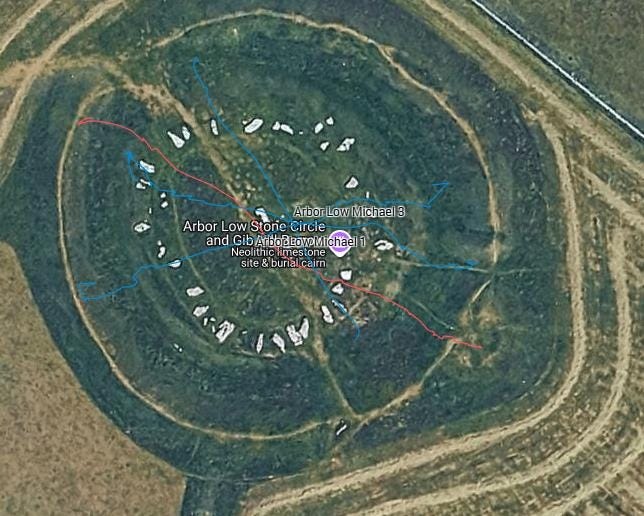
Business of the day completed, I head back towards Nottingham, once again stunned by the wealth of history and natural beauty which lies nearby.
Last week I made one of my regular visits to Sherwood Forest. Apart from it being a beautiful spot and very restful and restorative to walk through. There is almost no one around during the 2 or 3 hours that I walk, apart from - typically - 2 nudists. This is a bit of a thing in Sherwood Forest. I see these two passing and heading in the direction that I intend to go, so give them a bit of a head start … only to have one of them turn around and head back towards me. Now the etiquette generally seems to dictate that, if they approach one of the enclothed, they tactfully deploy a hat or shirt (they are pretty much exclusively male). Not so this time as this chap flapped jauntily towards me, gurning like a fool. I actually had dowsing rods in my hand and was tempted to give a disciplinary flick, but forbore.
But I digress, the point of mentioning Sherwood Forest (Major Oak RIP) is that there is history here that most people aren’t aware of and, as far as I can tell, goes unmentioned in the visitor Centre. I regularly visit Thyngehowe, an old Viking meeting place.
Again, knowing something of the derivation of place names is quite informative here. Anything with “thing”, “thynge” (Norse þing), in the name is likely to be a Viking assembly point. Howe is from “haugr”, being mound, hill, barrow (Norse for “Low” I guess but spelled more like high). Funny old thing language!
So Thyngehowe is the Hill of Assembly. There is not that much to see there - a clearing and a few stones (which I suspect may have been for axe sharpening and beheadings, but I am just guessing)


Nottingham was firmly within the Danelaw - the part of England under Viking domination during Saxon times and Thyngehowe is right on the border of the ancient kingdoms of Mercia and Northumbria, which probably means that it was a significant spot at the time. The border runs for some way through Sherwood Forest (interestingly, you seem to be able to detect the border with dowsing rods - don’t know why but I have a few theories!). I’m amazed that, with the popularity of series like Vikings and The Last Kingdom, these areas are not more popular.
Moving on from Thyngehowe, across the Robin Hood Way, you get to St. Edwin’s Cross. This stands on the original site of St. Edwin’s Chapel where legend has it that the body of Edwin, the first Christian king of Northumbria, was rested in a chapel here as it was carried back to York after he was killed in the Battle of Hatfield Chase in around 632 AD. This is, of course, how Edwinstowe (Edwin’s resting place) got its name. I’m pretty sure that none of the school trips to Sherwood Forest go beyond the legend that Robin Hood and Maid Marian were married in the local church.
I weep for the youth!
If they need a good use for AI, they should use it to inquire about your local area and then go explore!
I have recently been rediscovering the land of my youth. There is so much in North Wales that I wasn’t aware of when I lived there that I have determined to try and visit somewhere new each time I go back to visit my parents.
So far, this has involved a Roman bath house at the end of a cul-de-sac in Prestatyn


I’m not sure that I could recommend this. The woman who had cycled there seemed very disappointed. I had just driven there and parked in front of it, so hadn’t really invested significant time and effort. Still, the point is that I was not previously aware of its existence or that that this was a major lead mining area in Roman times.
Another recent discovery, and somewhat more impressive, is the Gop (or Y Gop I should say to keep the Welsh language police off my back). Now this is a huge man-made mound second only in size to Silbury Hill at Avebury (which is the largest man-made mound in Europe). Like Silbury Hill, no one knows what it was for. Neither are burial sites.
I am staggered that nobody seems to know of the existence of this place. Anywhere else, it would be a major tourist site.
It is about 5 miles from where I spent my teenage years and I had never heard of it. It is just a short walk from Trelawnyd. The trail, it appears, is also a bridleway and I skip around the large piles of dung as I work my way up the hill. At the top, the wind picked up dramatically and I suspected that the Welsh druids must have left some anti-English hex on it (my Celtic origins seem to be weirdly Scottish and Irish, with very little Welsh heritage).


The hex still seemed to be working on the way down, befuddling my senses and causing me to forget exactly where the path down was. As luck would have it, I could follow the dung, like a trail of large, evil-smelling breadcrumbs.
On a previous visit, I decided to call in at St. Winefride’s Well (in Holywell, obviously). I had been aware of this place, but had never previously gotten around to visiting.
It is actually one of the oldest and most important pilgrimage sites in Britain.
Quick back story: Winefrid was the daughter of a 7th century Welsh chieftain. She was supposed to marry Caradog, a local nobleman, but refused. In the way of the terminally entitled, he felt this was a cue to behead her. Where her head fell, a spring rose up. Her uncle (also a saint) Beuno recovered the head, prayed over it and she was restored to life.
The well had papal backing and was visited by kings. It survived the reformation due to its prominence and is generally considered the Lourdes of Britain.
Worth a look I felt.
Having paid my entrance fee, I was informed that there is a tap where I can acquire some of the holy fluid. Sadly, I had forgotten to bring a bottle. I am informed that they sell them in the shop. Of course they do! They do charge a fair amount for a very small bottle though. It does not compare well with the Chalice Well in Glastonbury. The staff are very quietly spoken and there is something a bit odd and detached about the way they interact. I suspect that they are all quite devout and earnest, but to me, it just felt a bit cult-like. That said, it is a special spot and I had it all to myself.


Holy wells are remarkably common around the country (I imagine that anywhere with clean drinking water was sacred at some points in history and may well be again if the water companies keep up their fine work!) and are a good excuse to get out and explore bits of the countryside.
I recently went in search of one near Clifton Village, a few miles form where I live. There wasn’t that much to see at the “well” but the walk was excellent and it was peak bluebell season.


I followed the energy back from the well to the village and, unsurprisingly, was led to St. Mary’s church. Pagan sites were often dedicated to Solar/Male energies or Earth/Female. The Solar ones are usually on hills, the Earth ones are often in valleys and particularly near springs. The early Christians often built churches on these sites to subvert the pagan use and dedicated the high ones to St. Michael and the low ones to St. Mary. Next time you see a church dedicated to one of these saints, look at where it is located. Again, this sort of thing makes you view the country in a whole new light.
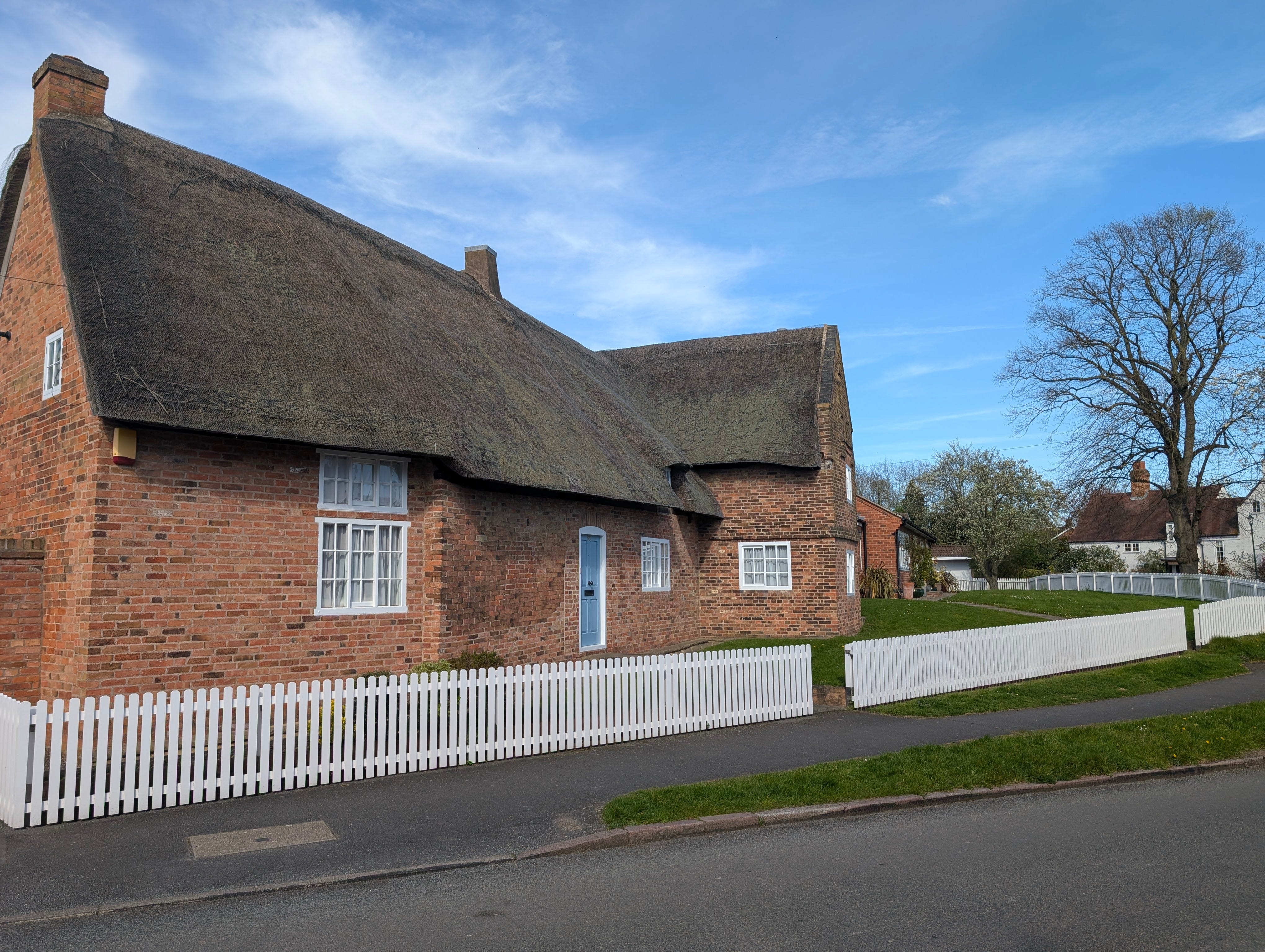
Clifton Village, it seemed, had other points of interest, including thatched cottages
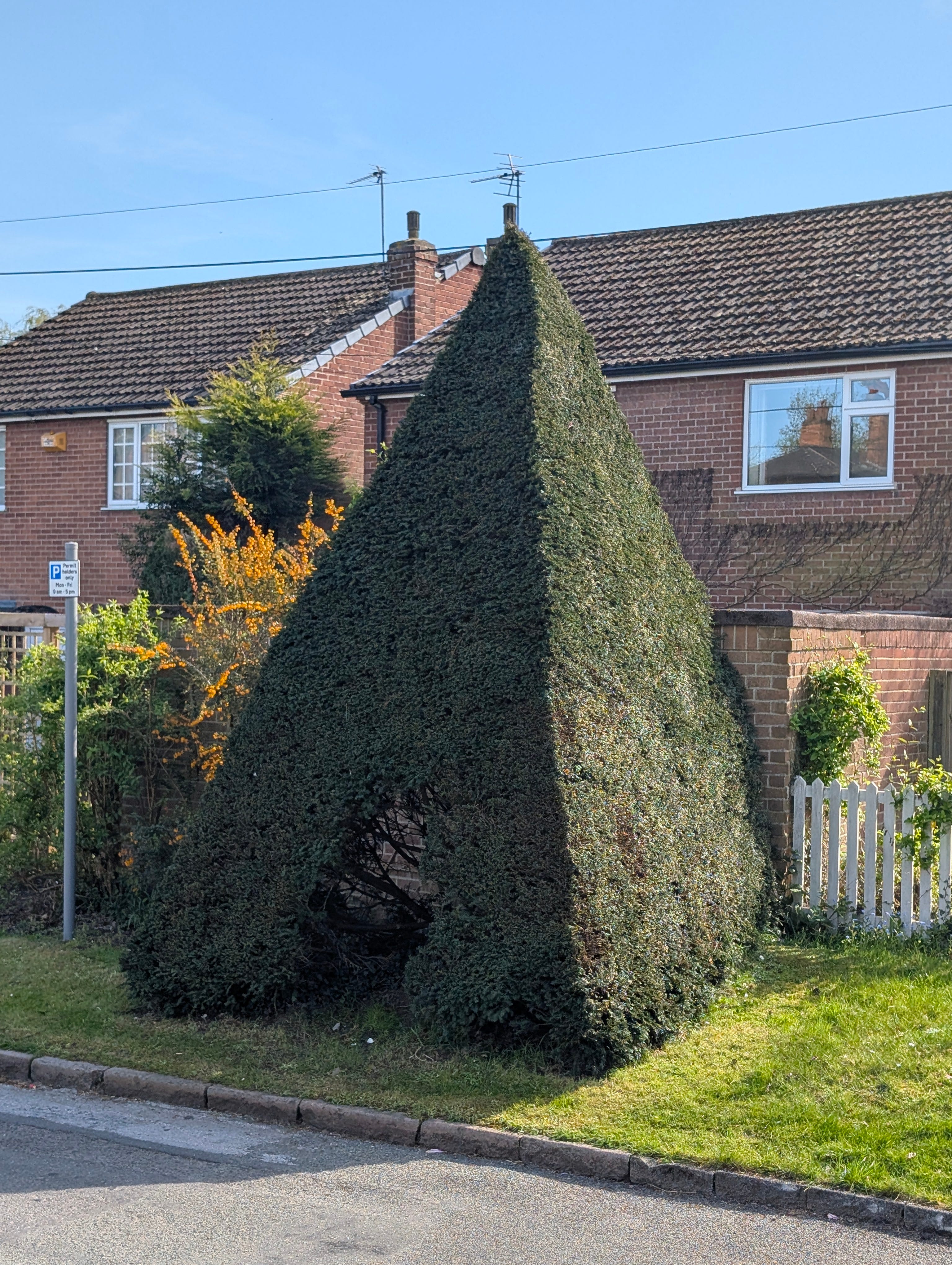
… and whatever this is …
So, the point of this post was largely to remind myself that there is much to be seen and appreciated locally, without having to travel far. I thoroughly recommend sites such as
to help with the discovery, as well as the various heritage databases, Whether you are interested in history, folklore or just need an excuse to go exploring, delve into what is nearby and have at it!