

I begin to wonder at some of the references that I include in titles just because they seem mildly amusing to me at the time. This one will only resonate with a fairly niche audience, although I know at least one reader of the blog will get the reference (you know who you are, but I won’t out you!). That said, it absolutely fits the business of the day.
I’m heading back to Nottingham today - although not by a straight route (oddly after all of my references to alignments and the Old Straight Track) as there is still more to see whilst I am down here.
First up, some unfinished business from yesterday. In retrospect, I am glad that I didn’t go in search of Gog and Magog yesterday as I suspect that
(a) it would have been quite a hike from the town centre and
(b) it would have been a damp and muddy old trek
Much better to approach it today by driving most of the way and then walking the remainder in the crisp morning sunshine.
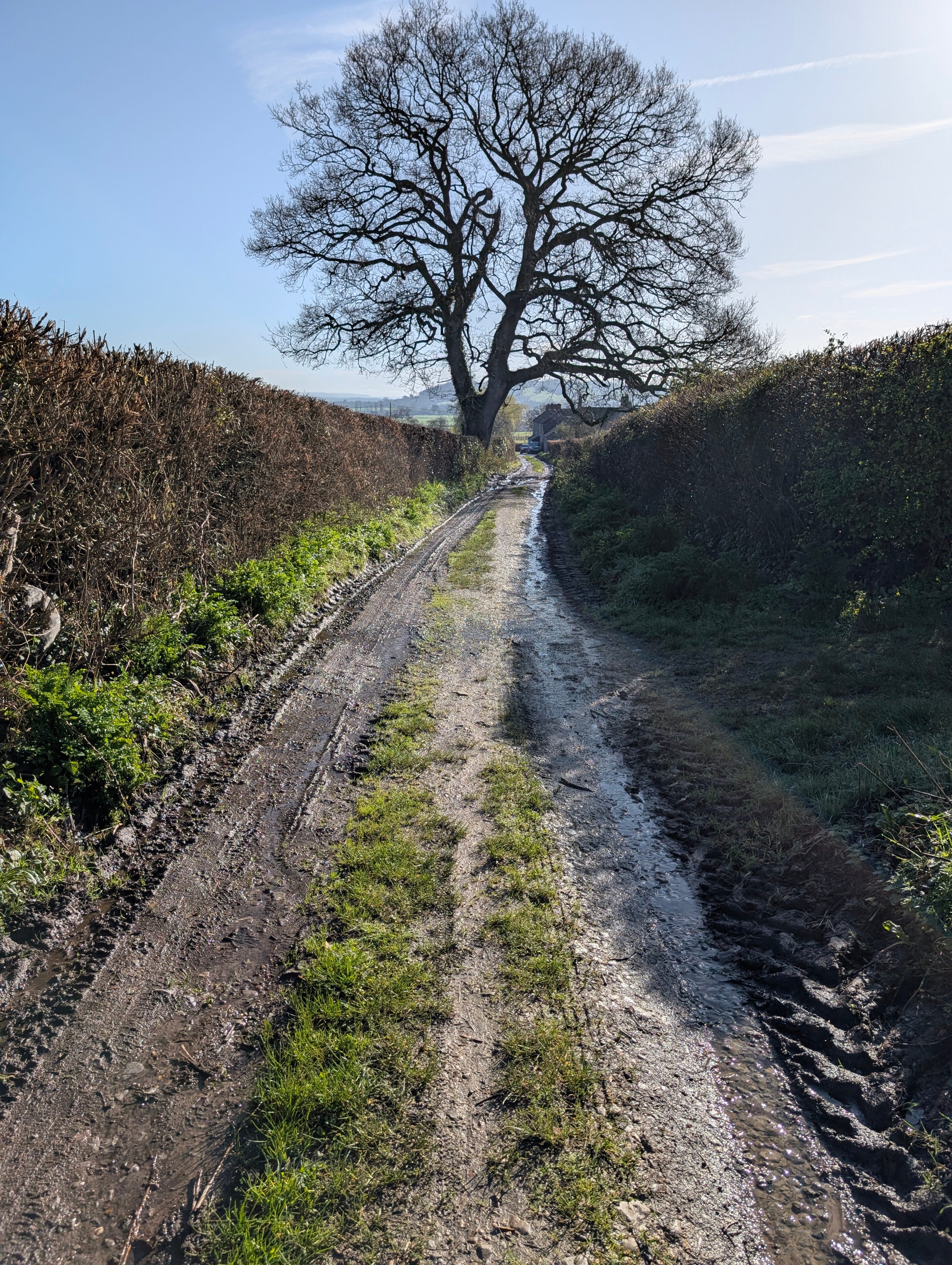
A review that I read on Google Maps said, “It’s a strenuous walk [it isn’t] and at the end of it its basically just a couple of trees”. Philistine.
The oak is indisputably the king of trees. I know that this doesn’t require saying, but I’m just ensuring that we are on theme.
Now I am very keen on ancient oaks, being a regular visitor to admire the many fine specimens in Sherwood Forest. Why then go out of your way to visit just two I hear you say. I am glad you asked.
Gog and Magog are the last two remaining Avalon Oaks. The story is that Joseph followed a line of trees up to the Tor. So the trees were already around at that point. It is thought that this was a ceremonial avenue. Must have looked magnificent.
And was cut down in 1906 to make way for a farm.
Sigh
Someone from the timber firm remembers that the trees were more than 11 feet in diameter and had more than 2000 growth rings. Let’s hope that the sheep appreciate the sacrifice.
And now there are two left. Hence the visit. These trees are a link with the deep past, and probably won’t be there much longer. Actually, technically there is one left as Gog has now expired (and Magog is teetering I gather).
Apparently a tee light was left in the Gog in 2016 (the tree was already dead at this point), presumably as some sort of pagan devotional act and, shockingly, the tree caught fire. The fire was put out, but a bit of a pagan own goal there I can’t help but feel.


Respects paid to Gog and Magog, I get back on the King Arthur trail and head to Camelot.
Now there are many places which lay claim to being Camelot but Cadbury Castle probably has one of the more credible ones. It is an immense hill fort which has been in use since the bronze age. There are signs of it having been taken by the Romans but then later reused by the Britons after the Romans left (which is exactly the period that people think Arthur legends stem from).
Excavations have show signs of great fortifications (the site is easily big enough to hold a small army), great halls, metal working and pottery from Europe, showing signs of international trade during the 6th century. So clearly not somewhere that descended into dark age chaos. It is also by far the largest such settlement of the period in southern Britain.
Also, when John Leland first wrote about it in 1542, apparently the locals had many legends about ghostly knights and also referred to the site as Camelot. Then again, as we know, many folk have tried to make this link with various places, including reasonably credible claims for sites on the Welsh borders.
Having stood on the ramparts and admired the view (and strategic location), I could well believe that if you were a major warlord in the 6th century, you would base yourself here. Looking at the landscape, I imagine that it would have been quite an experience to approach a large fortification here from rural England at the time. And it has a certain appeal given the proximity to Avalon. I’ll take it.


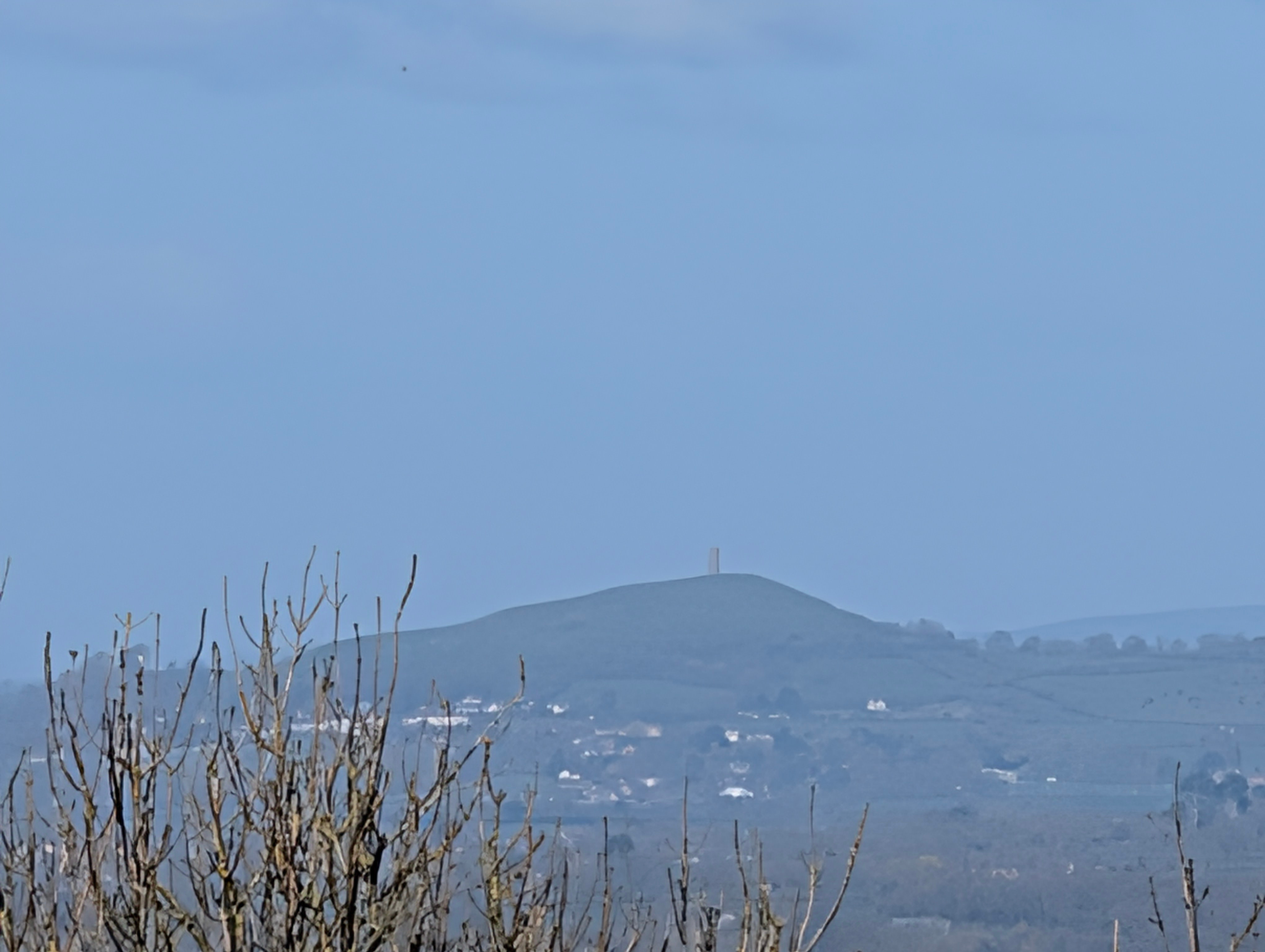
And I can’t leave the area without another nod to King Alfred.
Tucked away in … well … the arse end of nowhere really, is King Alfred’s Tower. This is nothing to do with Alfred in a sense, it having been built in the 1700s. As to its purpose, I will let a quote from Wikipedia do the heavy lifting here…
Henry Hoare II planned the tower in the 1760s to commemorate the end of the Seven Years’ War against France and the accession of King George III, and it was erected near the site of Egbert’s Stone, where it is believed that Alfred the Great, King of Wessex, rallied the Anglo-Saxons in 878 before the Battle of Edington. The tower was damaged by an aeroplane in 1944 and restored in the 1980s.
The 49-metre-high (161 ft) triangular tower has a hollow centre and is climbed by means of a spiral staircase in one of the corner projections. It has a statue of King Alfred and a dedication inscription.
Yes and no. It has a statue, sure. Can be climbed? Not so much. At least not in March. As with so much of Britain, it doesn’t open until April. As if people only visit places in the summer. Time to think about those poor retirees who need off-season access I say!
Still, middle of nowhere it may be, but it is a magnificent structure


Oh. and for those Last Kingdom fans (or just history buffs generally I guess), this is near the location of Egbert’s Stone where Alfred, coming out of hiding in the marshes of Athelney, raised his standard to rally the troops before heading off to the battle of Efandon, where he defeated the Danes. Although possibly not as well known as other battles, this would have been a pivotal point in English history (accepted that there wasn’t an England at the time … and probably wouldn’t have been if Alfred had lost this battle).
Anyway, it seems like this trip has had a certain amount of closure, linking a number of the themes from the last few days, so I can head home satisfied.
Surprisingly, I encounter another English tradition on the way home : the Highwayman. Driving through a small village (which Google has determined as the best route between Alfred’s Tower and the M4) the traffic grinds to a halt and a dodgy looking character shoves a a card payment machine through my window. He doesn’t look terribly official and I ask him how much the “toll” is. He very grumpily points to some signs that I hadn’t seen by of explanation. I point out that is attitude is less than helpful and that the signage could be better, which brings an angry retort. Having paid my £1.20, I feel I have the moral high ground and move on musing over the fact that we still have bandits in the country.
This gets me thinking again of passing through Bristol and the Clean Air Zone charge. I had to check this after the fact. You get no notification, you are just expected to know and pay up. Or preferably not and then they can fine you.
As I say, bandits are alive and well in Britain today. Wouldn’t have gotten away with it in Alfred’s day! :-)
Another well-researched and interesting read.
It looks like you turned your gaze from the castles in the distance 😊
I'm tempted to look into ley lines now, you crazy old hippy!